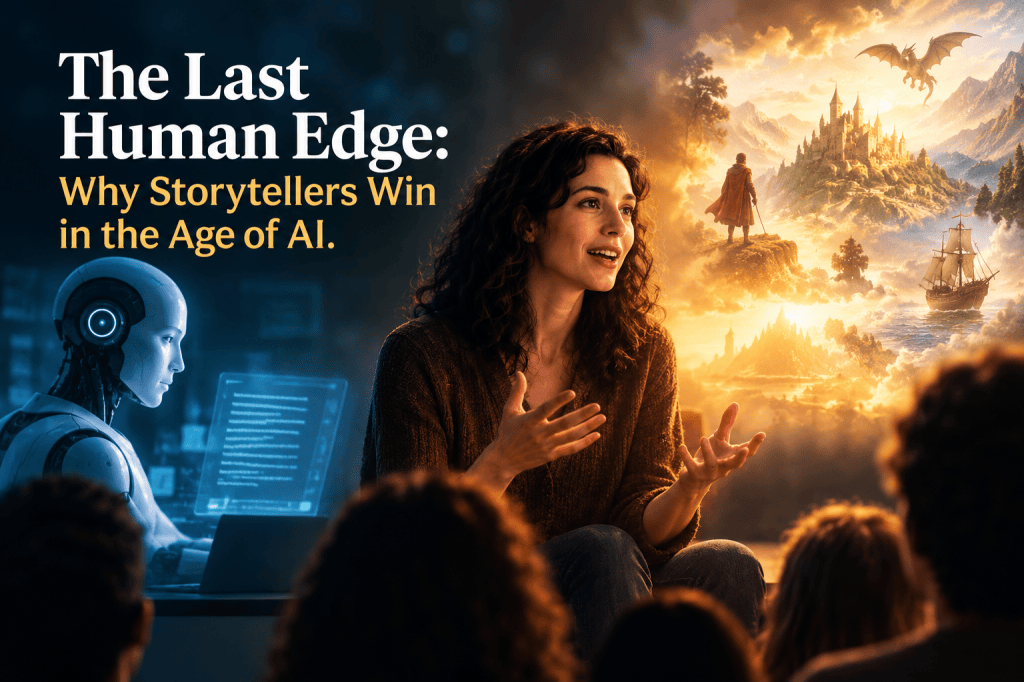
AI can write a story. It can’t be the storyteller. And as AI floods every inbox, feed and pitch deck with polished content, the people who can tell a story and stand behind it are becoming more valuable, not less.
I didn’t learn that from a book. I learned it by spending my career as an entrepreneur, setting companies up from nothing. Every one of them started the same way: a vision for a product that didn’t exist yet. Before there was any code, any customers or any revenue, there was only a story about what could be.
That story had to do a lot of work. It had to convince the first engineers to build something with me when there was nothing to show them. It had to convince the first customers to take a chance on a product that was barely finished. It had to keep a growing team pulling in the same direction through the hard months, when the plan wasn’t working and people needed a reason to stay. And eventually, when we sold AgentPoint to Reapit in 2021, the buyer wasn’t just buying code and a customer list. They were buying a story about where real estate software was going.
Vision, building, selling, leading. Different jobs, same underlying skill. Every step of being an entrepreneur is storytelling.
The paradox of infinite content
When something becomes free, whatever is still scarce becomes valuable. AI has made words, slides, emails and analysis effectively free. Anyone can now produce a decent proposal in 30 seconds. So can your competitor. So can every other vendor in the buyer’s inbox.
What AI hasn’t made abundant is trust. A buyer doesn’t sign a contract because the deck was well written. They sign because a person they believe looked them in the eye, told them a story about how their business gets better, and put their own reputation on the line.
That’s the shift I think most people are missing. The more content machines produce, the more each piece of it gets discounted, and the more we look for a human we can believe.
It was always this way
In Sapiens, Yuval Noah Harari argues that humans didn’t come to dominate the planet because we were the strongest or even the smartest. We won because we can cooperate in huge numbers around shared stories. Nations, money, religions and companies only exist because enough people believe the same story about them. A company is a story that employees, customers and investors agree to believe.
In 2005, almost two decades before ChatGPT, Daniel Pink wrote A Whole New Mind. His argument was that automation and offshoring would commoditise logical, rules-based work, and that a handful of human “senses” would become the new premium skills. One of them was Story. He called it early.
Morgan Housel put it most simply in Same as Ever, in a chapter titled “Best Story Wins”. The best idea doesn’t win. The best product doesn’t always win. The best story wins. As an investor I see this constantly. Markets don’t move on spreadsheets alone; they move on the narrative people build around the numbers.
Scott Galloway’s bet: storytelling over STEM
Scott Galloway, NYU professor and one of the sharpest business commentators around, gets asked what skill parents should teach their kids. His answer isn’t coding, STEM or even a liberal arts degree. It’s storytelling.
On The Diary of a CEO with Steven Bartlett in 2026, he called it “the enduring skill”, defining it as “your ability to look at data, create a narrative arc, and then communicate that story in a compelling way.” He added that technology “is going to create an equalization among the products”, which leaves one thing to compete on: “the point of differentiation is relationships.” His test for who people choose to work with is wonderfully human: “Do I want to work with this person? Do I know about their kids? Do I like them?”
The evidence
This isn’t just opinion from people who sell books and speaking gigs. The research points the same way.
Employers are still asking for it. The World Economic Forum’s Future of Jobs Report 2025 expects 39% of core skills to change by 2030. Alongside AI and big data, the skills growing in importance include creative thinking and “leadership and social influence”. LinkedIn’s 2026 Skills on the Rise list puts executive communication, public speaking and business development right next to prompt engineering. WEF · LinkedIn
Stories stick, statistics don’t. In Made to Stick, Chip and Dan Heath describe a Stanford class exercise where 63% of students remembered the stories from a set of presentations, but only 5% remembered any individual statistic. Stanford’s Jennifer Aaker puts it more bluntly: stories are remembered “up to 22 times more than facts alone.” Stanford
[embed: node/8cf2f84e-e75c]
Too much data can actually kill the sale. In a well-known study by Deborah Small, George Loewenstein and Paul Slovic, people gave about twice as much to help a single named girl, Rokia, as they did when shown statistics about millions facing famine. When the researchers added the statistics to Rokia’s story, giving went down. Every salesperson who has buried a client in a 60-slide deck should read that twice. Stanford GSB
A story can multiply value. In the 2009 Significant Objects project, researchers bought thrift-shop junk for a total of $128.74. Writers then attached a short made-up story to each item, and they resold the lot on eBay for $3,612.51. Same objects, a 2,700% markup, driven by story alone. The Marginalian
[embed: node/012c1b7b-1f02]
Here’s the AI-specific finding. A 2026 study in the Journal of Experimental Psychology: General by Manav Raj, Justin Berg and Rob Seamans tested 27,491 people across 16 experiments. Identical pieces of writing were rated lower when readers were told AI wrote them. Calling it a human-AI collaboration didn’t help, and neither did giving the AI a human name. The main reason was perceived authenticity. PsyPost
That last one is the heart of this article. The same words land differently depending on who we believe is behind them. AI can produce the story. It can’t supply the authenticity.
The honest counterpoint: the order-taker is dying
I’d be telling you only half the story if I stopped there. Gartner’s March 2026 survey of 646 B2B buyers found 67% now prefer a rep-free buying experience, up from 61% the year before. And 45% had used AI during a recent purchase. Gartner
[embed: node/0ec259e0-33e0]
On the surface, that sounds like the end of sales as a career. I read it differently. Buyers don’t want a human who reads out the feature list, sends the brochure and chases for a signature. AI does that better, faster and without the awkward follow-up calls. That job is going away.
What’s left is the part that was always the real job: helping a buyer feel confident about a big decision. Gartner itself tells sales leaders to focus their people on “value articulation”, which is a corporate way of saying tell a better story about why this matters. The order-taker disappears. The storyteller becomes more valuable.
What it means, role by role
BDMs and salespeople. AI will do your research, write your first-draft emails, summarise your calls and update the CRM. Good. That frees you for the only part that closes deals: the story of why this, why now and why us, told by someone the buyer trusts. If your edge was knowing the product specs, you’re in trouble. If your edge is making a client feel understood, you’ve never been in a stronger position.
CEOs and founders. Raising capital, hiring great people, keeping a team together through a hard year and selling the company one day all come down to narrative. Investors fund a story about the future. Talented people join a story they want to be part of. Galloway made his fortune helping CEOs tell that story to the market.
Look at the founders who built the companies we all know, and you find a storyteller at the centre of almost every one:
- Steve Jobs (Apple). At the 2007 iPhone launch he announced “an iPod, a phone and an internet communicator”, repeating it until the audience realised it was one device. His 2005 Stanford commencement speech was simply “three stories” from his life.
- Howard Schultz (Starbucks). He never sold coffee. He sold a “third place” between home and work, a story that began with him walking through Milan’s espresso bars in 1983.
- Phil Knight (Nike). His memoir Shoe Dog tells of a young man selling Japanese running shoes out of his car. Nike has been built on athletes’ stories ever since, not on the shoes themselves.
- Richard Branson (Virgin). He cast Virgin as the scrappy underdog taking on British Airways and the big banks. That one story made the brand believable in airlines, music, mobile and banking.
- Jeff Bezos (Amazon). He banned PowerPoint from senior meetings and replaced it with six-page narrative memos, believing a story forces clearer thinking than bullet points. His “it’s always Day 1” shareholder letters are still studied today.
- Melanie Perkins (Canva). Closer to home, she was rejected by more than 100 investors before her story about making design simple for everyone finally landed. Canva is now one of Australia’s most valuable companies. Fortune
- Brian Chesky (Airbnb). The founding story of renting air mattresses in a San Francisco flat, and selling novelty “Obama O’s” cereal boxes to stay afloat, helped investors and guests trust what sounded like a strange idea.
None of them won because their first product was perfect. They won because they could make other people see what they saw.
Then there’s Adam Neumann, who shows just how far a founder’s story can go. He didn’t pitch WeWork as a company that leased office space. He pitched it as a movement that would “elevate the world’s consciousness”, and investors valued it at around $47 billion. When the 2019 IPO filing exposed the numbers behind the story, the valuation collapsed to around $8 billion and he was pushed out. Yet in 2022, Andreessen Horowitz wrote the biggest single check in its history, $350 million, to back his next venture, Flow, valuing it at over $1 billion before it had opened. TechCrunch
Neumann is both a lesson and a warning. A great story can raise billions. But a story the business can’t back up eventually gets found out. The storytellers who last are the ones whose story is true.
Managers. Nobody follows a dashboard. People follow someone who can explain where the team is going and why their work matters. Deming’s research found social skills “reduce the cost of coordinating with others”. In plain English, a manager who can tell the story gets the team pulling in the same direction with fewer meetings.
Everyone else. The junior analyst who forwards the AI’s output is replaceable. The one who says “here’s what this means, and here’s what I think we should do” is not. Every industry and every role still needs people who can turn information into meaning, and meaning into action.
How to get better at it
The good news is that storytelling is a skill, not a gift. Galloway’s own five-step approach is a solid place to start:
- Listen. Understand what your audience actually cares about before you open your mouth.
- Evaluate. Work out which of your facts genuinely matter to them.
- Frame. Build a simple arc: where they are, what’s at stake, where they could be.
- Be fearless. Have a point of view. A story with no opinion is just a report.
- Deliver. Keep it short, and assume your audience is smart and likes you.
A few habits I’d add from my own experience:
- Lead with one person, not a statistic. Rokia beats “millions” every time.
- Use AI for the research and the first draft, then add the parts only you can: what you saw, what you got wrong, what you’d bet on.
- Collect your own stories. Every win, loss and awkward client meeting is material.
- Practise out loud. A story that reads well and one that lands in a room are different things.
For further reading, Kindra Hall’s Stories That Stick, Carmine Gallo’s The Storyteller’s Secret and Donald Miller’s Building a StoryBrand are all practical and business-focused.
The last human edge
AI will keep getting better at writing. It may well write better than most of us within a few years. But business has never been a writing competition. It’s a trust competition, and trust is given to people, not to paragraphs.
So if you’re worried about where your career goes in the age of AI, here’s my advice. Learn the tools, absolutely. But spend at least as much time learning to tell a story that makes people believe. Whether you’re a BDM, a CEO, a manager or just starting out, that’s the one skill the machines are making more valuable every day.