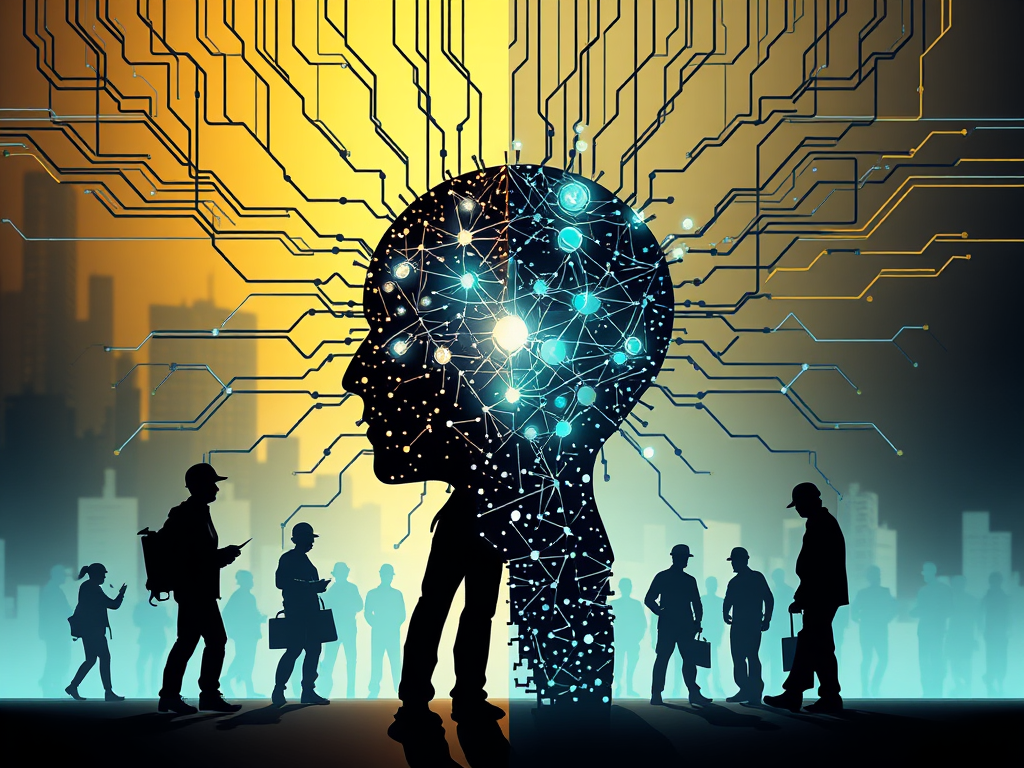
For most of modern history, there has been a simple bargain underpinning capitalism.
If you worked hard, acquired skills, and stayed competitive, society would reward you with rising wages, economic security, and a stake in the future. Capital needed labor. Labor became consumers. Governments taxed both. Everyone, imperfectly, but meaningfully, participated.
That bargain is now breaking.
Artificial intelligence isn’t just another productivity tool. It isn’t the next spreadsheet, the next ERP system, or even the next wave of automation. AI represents something fundamentally different: the first time in history that capital can grow without needing human labor at scale.
And once that dependency is broken, everything else begins to unravel.
Growth Without Jobs Is the Tell
We’re already seeing the early signals.
Economic growth remains strong. Corporate margins are near record highs. Equity markets continue to reward efficiency. And yet job creation……particularly in white-collar sectors, has stalled or reversed.
This isn’t a recession signal. It’s something more unsettling.
Historically, productivity gains created new categories of employment. Farmers became factory workers. Factory workers became office workers. Each wave preserved the same core structure: human effort produced value, value produced wages, wages produced consumption.
AI breaks that loop.
When companies can expand output, improve service, and lift margins while employing fewer people, labor stops being a requirement for prosperity. It becomes optional. Convenient, sometimes useful………..but no longer structurally necessary.
That distinction matters more than most people realise.
Why “New Jobs Will Be Created” Is the Wrong Question
Every technological transition has triggered the same reassurance:
“Yes, some jobs disappear, but new ones will be created.”
This line has always been technically true…….and practically misleading.
AI will create new roles. But not nearly enough to absorb the scale of displacement occurring across knowledge work. And more importantly, many of those new jobs won’t sit in the same income, status, or security bands as the ones being lost.
There are some forecasts indicating that over 50% of white-collar jobs will disappear. The uncomfortable reality is that a large portion of displaced white-collar workers will not move sideways. They will move down.
Into:
- Care work
- Aged care
- Healthcare support
- Trades
- Manual and service-oriented roles
These jobs matter deeply to society, especially as populations age. But economically, they share a problem: they don’t generate the surplus capital that most white-collar jobs do.
You cannot build long-term wealth, save aggressively, or invest meaningfully on wages that barely cover living costs. And you certainly can’t replace a broad, tax-paying middle class with a service economy that runs on thin margins and emotional labour.
AI Isn’t Automation, It’s Competition
The more honest way to describe AI is not as a tool, but as a competitor.
A competitor that:
- Works 24/7
- Never tires
- Never negotiates
- Improves continuously
- Operates at near-zero marginal cost
This is not the Industrial Revolution repeated. We have never before introduced a workforce that can outperform humans cognitively while compounding its capability every year.
The psychological shock here is enormous.
Entire generations were raised inside a meritocratic framework:
Study hard. Compete. Specialise. Outwork your peers.
AI doesn’t just threaten jobs ……it invalidates the rules of competition. You cannot outwork something that doesn’t experience fatigue. You cannot outlearn something that improves while you sleep. And you cannot “be the best” in a market with no upper bound on intelligence or output.
For many, this isn’t just economic displacement. It’s an identity crisis.
The Quiet Shift Toward State Support
As more people fall out of high-earning, surplus-generating work, governments face an impossible equation.
Consumption must continue, the economy depends on it.
Tax revenue weakens as wages stagnate.vEssential services become more expensive as populations age.
The response is predictable.
More support. More transfers. Eventually, some form of Universal Basic Income or guaranteed minimum income becomes unavoidable……..not as ideology, but as economic necessity.
And that support will not be funded through productivity alone.
It will be funded through money creation.
Which brings us to the part few want to say out loud.
Asset Owners Win This Transition
When governments print money to stabilise demand, the value doesn’t distribute evenly.
It flows first and most powerfully……..into assets.
Real estate. Equities. Private businesses. Infrastructure. Scarce digital assets.
Those who own assets benefit from rising nominal prices. Those who rely on wages experience cost-of-living pressure without corresponding income growth.
This dynamic is already visible today. The top 10% of households now account for more than half of total consumption……..and that share continues to rise. Not because the wealthy are suddenly more extravagant, but because everyone else is increasingly constrained.
AI accelerates this trend.
As labor’s bargaining power weakens, capital’s share of output grows. And capital ownership is already heavily concentrated. The result is a widening gap not just in income, but in participation in the economy itself.
The Future Isn’t Collapse. It’s Divergence
This doesn’t end in a single dramatic moment.
Systems don’t disappear overnight. They merge, overlap, and decay unevenly.
Some people will thrive inside the AI-augmented economy. Others will find stability in care, trades, and service roles. Many will depend, partially or fully, on government support. Asset markets will inflate even as sentiment deteriorates. Growth and discomfort will coexist.
This is not the end of capitalism…….but it is the end of the version where labor sat at its centre.
The new dividing line won’t be education alone. Or effort. Or even intelligence.
It will be ownership.
Ownership of assets. Ownership of systems. Ownership of leverage.
A Closing Thought
AI doesn’t make humans obsolete.
But it does make the old promise obsolete.
The idea that effort alone guarantees progress is no longer structurally true. The social contract that tied labor to prosperity is being rewritten in real time ………quietly, unevenly, and without ceremony.
Those who understand this early won’t panic.
They’ll adapt.
They’ll prioritise ownership over credentials. Resilience over titles. Optionality over optimisation.
Because in a world where machines work endlessly, the scarcest resource isn’t intelligence.
It’s leverage.





 TheBucket